

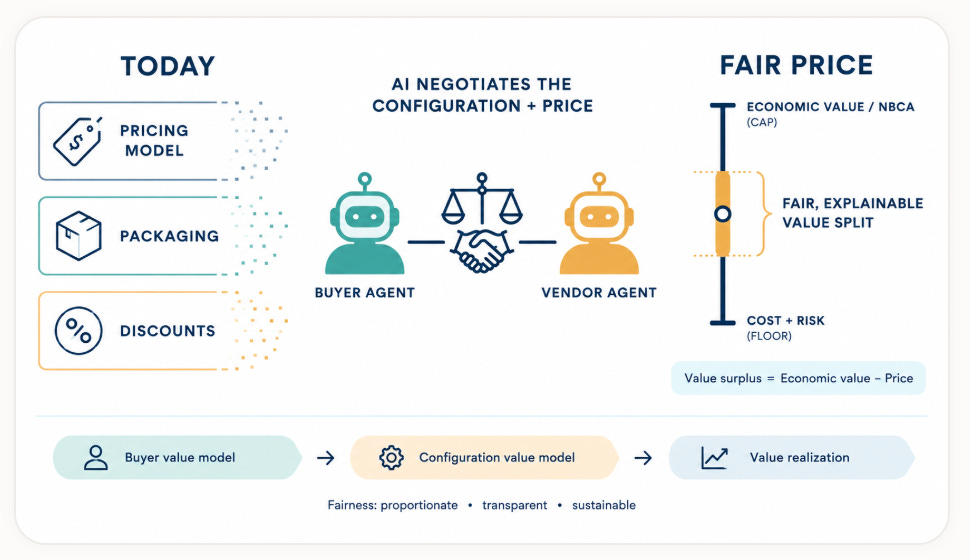
One thing we are doing as we work on the Pricing for the Agent Economy book is to interview experts with different perspectives. One of the interviews was with procurement expert Haris Rahi. Haris has a fascinating background, one quite different from the pricing, product and GTM people we usually talk to. At Accenture he was responsible for guiding major companies in how to buy and implement major software systems. He currently works with Google to support AI adoption. He does this directly with multidisciplinary teams across procurement, legal ops, sales enablement, finance, and operations, helping them build AI capability in-house rather than rent it.
During our conversation Haris asked a provocative question.
“Given the ability of AIs to manage complexity and find alignment is there any reason to have a pricing model.”
That stopped me in my tracks. He went on to say (I am paraphrasing a bit)…
“The buyer and vendor agents can negotiate the commercials between themselves and find a fair price. AI is full capable of managing that level of complexity.”
As someone who has made a living over the years designing pricing models and still guides people on their design this brought me face to face with my coming obsolescence! I expect that AIs will take over the design of pricing models, I am even contributing to some agents that will do this, but that there will be no need for pricing models at all … this makes me rethink a lot of basic assumptions.
With no pricing model concepts like discounts go away, so does packaging as pricing is one main reason to have packaging in the first place. The other main reason to have packaging is to make it easier for the seller to sell and the buyer to buy, but the argument against pricing models applies equally to packaging models. AIs don’t need a packaging model to figure out what functionality, data and services are needed to optimize value for a specific customer.
No pricing model, no packaging model, no discounting that is a very different world. It is Sangeet Paul Choudary’s question about what constraints does AI dissolve applied at a deep level. Pricing and packaging models are a constraint, a guide to action, that may not be needed in the immediate future.
Let’s assume for the moment that this is true, that pricing and packaging goes away, and that AI determines configuration and pricing. Imagine pricing systems that natively apply something like the Anthropic’s Constitution for Claude to ensure fair pricing.
The key term here is ‘fair price.’ What is a fair price and will we replace all of our other pricing frameworks with a simple idea, the fair pricing.
In my world a fair price is a price in which each party gets its fair share of the value created given their contributions and the risk they take on. Agreeing on a fair price implies some sort of solution to the value attribution problem. This is an unsolved problem at the heart of pricing that asks how much each party is contributing to value and how that is changing over time.
But I won’t be the one deciding if something is a fair price. And neither will you (unless you are an AI reading this, or some form of Centaur).
I asked a couple of AI’s “What is a fair price?”
Gemini (the one that is part of the Google suite)
“A fair price is generally defined as a transaction amount that is equitable and reasonable to both the buyer and the seller. Rather than being a single, fixed math equation, it represents a balance where the seller successfully covers their true operational costs and earns a reasonable profit, while the buyer receives equivalent value, quality, and service without being exploited.”
Perplexity (my personal version, heavily configured)
“A fair price is not necessarily a low price, a cost-plus price, or the prevailing market price. It is a price that a well-informed buyer can regard as proportionate to the value received, while allowing the seller to cover the real costs and risks of delivery and earn a sustainable return—under terms that are transparent and non-exploitative. It is best understood as a defensible range, not a single objectively correct number.
valueIQ Brain (a heavily configured version of Anthropic Claude with extentions)
“It’s anchored to economic value, not cost or gut feel. The core methodology (EVE — Economic Value Estimation) defines value as: Reference Value + Positive Differentiation − Negative Differentiation, measured against the customer’s Next Best Competitive Alternative (NBCA). A fair price sits inside the range that formula produces — it’s a ceiling set by what the customer actually gains, not by what it cost you to build the thing.
“Fair” is really about the surplus, not the number itself. valueIQ’s synthesis concept is Value Surplus = Total Economic Value − Total Price. A price is fair when that surplus is large enough and visible enough that the buyer can see they’re capturing more than they’re paying for. A price with a thin or invisible surplus isn’t fair even if the math technically works — the buyer has no proof they came out ahead.
It has to be provable, not just felt. The manifesto’s framing: “Cost is a floor. Value is a cap.” Fair price lives between those two lines — high enough to reflect real value delivered, low enough to stay under what the customer actually gains — and the whole point of a System of Value is that you can show your work on both ends rather than asserting a number.
Perception is part of the mechanism, not a distortion of it. Monroe’s Price-Quality-Value triangle and Reference Price Theory both say buyers judge fairness relative to an anchor and to perceived quality — which is why reflexive discounting backfires: it doesn’t just cut margin, it signals lower quality and resets the buyer’s anchor downward. A fair price defended with evidence reads as more legitimate than a lower, undefended one.
A fair price allocates the economic value created between customer and supplier in a way that is proportionate, explainable, consistent across comparable cases, and viable over time.”
Please run this prompt on your own AIs and share what you get. And put your personal definition of fair pricing in and see what the AI thinks.
My own view is that a value model (an EVE or Economic Value Estimation) as pioneered by Tom Nagle is the critical frame for a fair price. It establishes the range within a fair price can be negotiated between the buyer agent and vendor agent. Because it i
ncludes the Next Best Competitive Alternative (NBCA) or Reference Value the competitive dynamics are built in and one should assume that the buyer agent is configuring and negotiating with multiple vendor agents.
The most important value models will be the buyer value model and the configuration value model. These are discussed in A worth of value models.
Buyer Value Model: Value models generated by buyers to describe the value they are looking or. Replace antique things like RFPs and business case analysis.
Configuration Value Model: Value models provided by vendors and third parties that are used to configure solutions, choose agents, and that connect with Customer Success value models to make sure that the projected value is being realized.
Watching pricing and packaging models dissolve, and discounting fade away, is a big change for people working in Go-to-Market, product management, sales and pricing. But is may just be a bridge to a different world, one in which money itself dissolves away.
Money is an abstraction used to facilitate exchange and to share value. It has been around for a long time, but in an AI economy will it perform any useful function?
The AI companies are forecasting huge economic growth based on the general adoption of AI. As an example see Anthropic’s Economic Scenarios for the Future of AI. I am sceptical of these forecasts, and at the very least feel they should apply scenario planning and not just project ranges of growth, but let’s assume for a moment that they play out in a good way. What we end up with is a post scarcity society, one where AI has solved all of our most difficult problems (I know, this is not the only or even the most likely outcome).
We have a picture of such a society, it is the United Federation of Planets in Star Trek. The economy in this fantasy is …
Post-Scarcity: Technologies like replicators provide food, clothing, and basic goods instantly, removing the need to buy necessities.
No Accumulation of Wealth: Characters like Jean-Luc Picard explain that humanity has evolved past the drive for possessions and hunger, working instead for self-improvement and the betterment of society.
No Wages: Starfleet officers do not receive a salary or pay check
Is that a world you would like to live in? I would. I don’t expect to see it but hope that my grandchildren survive to see something like it. The dissolution of packaging and pricing models and their replacement with value models is a step towards this.
People know what they want, but not necessarily what they need. AI, depending on how each side configures it, will make negotiations more objective. What I don’t know is whether the outcome will be fair, or whether fairness even exists.
I would say a negotiation is fair when, at the end of the transaction, both parties feel they would be willing to sit down and negotiate with each other again.
My father in law famously said to the waiter "I know that is what I ordered, but it is not want I want". Both sides would need to commit to the fair price decided by the respective AI Agents.