
Portable and computable value and pricing models
The Value Project

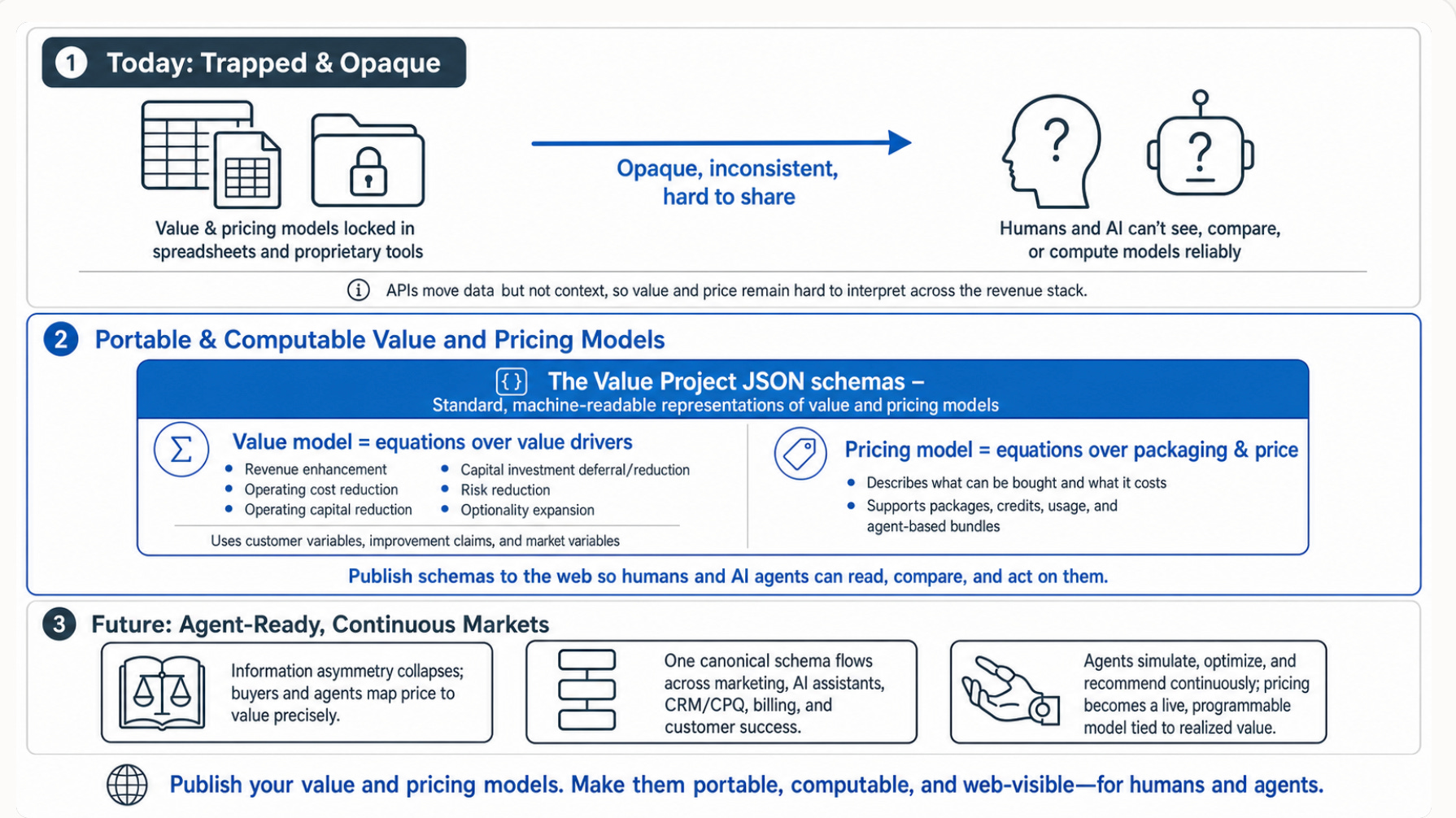
valueIQ, where I am a co-founder, has launched an open source project to make value models and pricing models more portable, transparent and AI friendly.
The Value Project website is here.
The Github repository for the two schema is here.
See also Rubrics for transparent and shareable pricing models.
TL:DR
The core idea: value models and pricing models should be portable, computable, and published in a standard format so humans and AI agents can understand them, compare them, and act on them.
Why it matters now: today these models are trapped in spreadsheets, proprietary tools, and internal knowledge, which creates opacity, inconsistency, and avoidable confusion in pricing and value communication.
Value models should be explicit: The post frames value models as equation-based structures built from customer variables, improvement claims, and market variables, with value drivers grouped into six categories: revenue enhancement, cost reduction, capital reduction/deferral, risk reduction, and optionality expansion.
Pricing models need the same treatment: pricing should be represented as a computable model of packaging and price, not a static pricing page, so customers, sales teams, and AI agents can calculate options, discounts, and willingness-to-pay more accurately.
The biggest shift is agent readiness: AI buying assistants will increasingly need machine-readable pricing and value data to recommend purchases, reconcile price with expected value, and reduce hallucinations or bad assumptions.
Integration is not enough: APIs move data, but they often miss the context needed to interpret that data; the post argues that value and pricing schemas need to flow across the revenue stack, from marketing and CRM to CPQ, billing, finance, and customer success.
Publishing to the web is strategic: if value and pricing models are visible on the web, AI systems can find and use them; if they are buried in docs or internal systems, they become effectively invisible to the new discovery layer.
The competitive implication is sharp: future winners will compete on model quality, transparency, and machine-readable economic logic, not just messaging, feature lists, or brand story.
Operationally, this changes GTM: sales shifts from gatekeeping information to stewarding models and handling exceptions, while pricing becomes more dynamic, more continuous, and more closely tied to realized customer value.
Actions to take: publish your value and pricing models, pressure-test them for contradictions, make them web-accessible, and design them so both humans and AI can evaluate them with confidence.
Why are we doing this?
For too long both value models and pricing models have been locked away. Value models because they were locked up in spreadsheets and proprietary systems, pricing models because they were regarded as company secrets, in many companies not even sales understands how prices are set (and discounts as a result).
There has been no common way to represent value or pricing and no easy way to share models and data across system.
The same is true when it comes to publishing these models to the web. There are many different ways to do this, when it is done what is shared is generally partial and also confusing. It is difficult for human buyers to understand and verify or for AI agents and AI answer engines to parse value claims and pricing information and pass that on for other uses (like buying or renewal decisions).
The Value Project is an attempt to address this by providing JSON templates that anyone can use to represent a value and pricing model and to publish this to the web.
What is a value model?
A value model as the term is used in The Value Project is based on Tom Nagle and collaborators seminal work in The Strategy and Tactics of Pricing (now in its Seventh Edition). Technically a value model is composed of value drivers and it estimates the economic value that a solution will provide to a specific customer. Value drivers can be put into six basic categories (see below) and each value driver is represented by an equation. There are several types of variables used in value driver equations.
Customer variables describing the customer
Improvement claims that the solution makes
Market variables, that can impact customer variables or improvement claims
These variables can be filled by ranges (distributions) or specific value.
The six common categories of value driver are …
Revenue Enhancement
Operating Cost Reduction
Operating Capital Reduction
Capital Investment Deferral or Reduction
Risk Reduction
Optionality Expansion
These six types of value driver impact the profit ad loss statement. In certain industries there are also balance sheet value drivers to consider.
Here is valueIQ’s value model for its Value Sales Agent on its website in the specified format (try pointing your AI at this and asking for an interpretation).
What is a pricing model?
A pricing model describes how functionality, data and services are packaged and priced. A pricing model defines what can be bought and how much it will cost.
Like a value model, a pricing model is a bundle of equations. In this case the customer (or more often sales on behalf of the customer) enters value for the variables that determine the price. In many Product Led Growth motions, this is simplified to simply picking a package and maybe specifying one or two variables. In Sales Led Growth there is often more complexity, and the sales person has some agency in providing discounts or even in assembling packages. In this case, the challenge becomes how to assemble to the package with the most value to the customer and sell it at a price close to the willingness to pay (WTP).
Today most pricing models are opaque, even when there is a pricing page, or at best incomplete. In the agent economy this will have to change. Agents will need to have access to pricing, to be able to connect price paid to value received, so that they can advise on or even execute a buying decision.
In fact, most pricing models are not just opaque, they are inconsistent and contain contradictions and ambiguities. One of the advantages of having a computable model is that contradictions are surfaced and resolved and ambiguities clarified.
Pricing models are a more difficult problem than value models. They are more diverse. There are many ways to package and price software and models are shifting rapidly. Two years ago few people talked about packaging functionality or data into intelligent agents, and outside of a few technical solutins like Snowflake credit based pricing was seen as a quaint historical artifact. Things are very different today. Agents are emerging as a dominant packaging pattern for AI and credit based pricing is the fasted growing approach to pricing.
Getting to a good standard schema that can represent this diversity and make it computable to external systems will be a challenge. A challenge I hope the pricing community will take on.
Here is valueIQ’s pricing model for its Value Sales Agent on its website in the specified format. Try pointing your AI at this and asking it to calculate a price and to recommend an option. valueIQ has two basic pricing models. (i) You can buy ad-hoc credits at any time to supplement the free credits that all users are gifitd. (ii) You can design your own subscription and make a monthly or annual commitment. Can a good prompt generate accurate pricing and recommend the right option? That is the test of the schema.
Why we need portable models
There are many systems in the revenue ecosystem that need value and pricing data. Today this is achieved in a few different ways. People are still entering data, or configuring applictions by hand, an error prone and time consuming approach. The better approach is to integrate through APIs. The problem here is that API integrations only cover the values for the data. They do not generally cover the context needed to interpret the data, and this context is of growing importance to AI powered agents and apps.
Access to the value model increases the power of apps from marketing and positioning, Digital Asset Management, Sales Assistants (agenetic or other), through CRM, CPQ (Configure Price Quote) and customer success.
There is an important overlap for pricing models, which are also used by the CRM, CPQ and customer success applications, but are also used by subscription management, billing and invoicing and finance applications.
The emerging generation of metrics management tools such as Confident AI, Galileo AI or Maxim AI.
Applications that can access and work with both value and pricing AIs get insight into both and can use insights from value to improve pricing and data on value to estimate key metrics like the Value Capture Ratio (VCR), the percent of value created by a solution that is captured back into price.
Why we need to publish models to the web
It is not enough to improve model level integration. The models need to be shared on the web. AI chatbots like ChatGPT, Perplexity and Gemini are basically highly intelligent search engines and depend on what they find on the web or what is fed to them. If your value model or pricing model is hidden in documents or buried in systems it is invisible to these applications and all of the agents that leverage them. When AIs can’t find data they sometimes halucinate, and you do not want AIs making things up about how you deliver value or what a customer will pay.
AIs are playing a growing role in the buying process. This does not necessarily mean that the AI is conducting the negotiation or making the final buying decision (that is happening, and happening more often). Most search today starts in an AI chatbot, not a search engine, and it is the AI that is evaluating your website. Providing the AI with what it needs to do its job effectively is a key to success in the new world we are working in. There are few things more important than conveying your value and helping the buyer understand how you price.
Imagine a future where these schema are widely adopted
Imagine the business ecosystem in a few years, when The Value Project schema are wdely adopted. Product websites communicate value in way that your AI can interpret and apply for specific customers. Pricing is transparent and connected to value. AI enabled buying processes and sales negotiations are seamless and the data flows over into the customer success management platform to enable upsell and renewals.
In this world, what changes?
What constraints that disappear from the ecosystem?
The first is information asymmetry. Today, value lives in internal spreadsheets and pricing lives behind negotiation, creating a structural imbalance between buyer and seller. With computable value and pricing schemas published to the web, that asymmetry collapses. Not because everything becomes “cheap,” but because everything becomes legible. Buyers—and increasingly their agents—can map price to value with precision. Sellers can no longer rely on opacity; they compete on clarity, credibility, and provable impact.
The second constraint is translation friction across systems. Today, value narratives degrade as they move from marketing to sales to finance to customer success. Each function reinterprets, rekeys, or simplifies. The schema layer removes that translation tax. A single canonical representation of value and price flows across the revenue stack—marketing sites, AI assistants, CRM, CPQ, billing, and customer success—without loss of meaning. What changes is not just efficiency, but coherence: every function operates on the same economic truth.
The third constraint is human bandwidth in complex decision-making. Enterprise buying has always been constrained by the ability of humans to model scenarios, compare options, and negotiate outcomes. Once value and pricing are machine-readable, agents take over this computational burden. They simulate, optimize, and recommend continuously. The bottleneck shifts from “can we analyze this?” to “do we trust and accept the outcome?” This is the foundation of agentic commerce.
The fourth constraint is static packaging and pricing rigidity. Today’s pricing models are designed to be explainable to humans, not optimized for outcomes. That constraint disappears when pricing becomes computable and dynamically interpretable. Packaging evolves from fixed tiers to adaptive configurations—assembled in real time based on customer context, value drivers, and willingness to pay. Credit systems, usage models, and agent-based bundles converge into a unified, programmable pricing layer.
The fifth constraint is the disconnect between value creation and value capture. Most companies operate with limited visibility into their Value Capture Ratio. With both value and pricing models instrumented and interoperable, this becomes a continuously measured variable. Pricing is no longer set episodically; it is tuned in response to observed value realization. This creates a feedback loop where product, pricing, and customer success converge around a shared objective: maximizing realized and captured value.
What emerges from the removal of these constraints is a different kind of market.
Markets become computational and continuous rather than episodic and negotiated. Discovery, evaluation, and purchase collapse into a single flow where agents query value models, simulate outcomes, and execute transactions. The “pricing page” is no longer a static artifact—it is an interface to a live economic model.
Competition shifts from feature comparison to model competition. Vendors differentiate on how well their value models reflect reality, how transparently they communicate assumptions, and how efficiently their pricing models capture value without introducing friction. The best models become distribution channels: if your value schema is trusted and easily consumed by agents, you get pulled into more buying journeys by default.
Go-to-market becomes schema-native. Instead of crafting messaging first and models second, companies design value and pricing models as primary artifacts, then render them into human-readable narratives. The website is no longer just a storytelling surface; it is an API for agents.
Sales doesn’t disappear, but it is reconfigured. The role shifts from information gatekeeping to model stewardship and exception handling—guiding edge cases, validating assumptions, and shaping complex, high-stakes decisions where human judgment still matters.
And perhaps most importantly, trust is rebuilt on a new foundation. Not through brand or relationship alone, but through transparent, verifiable economics. When an AI can inspect your value claims, trace them to equations, and reconcile them with price, credibility becomes programmable.
Conclusion - help make change happen
You can help to make this change happen by getting involved.
Comment on the schemas and help to improve them.
Publish your value and pricing models to your website. If you need help, contact me steven@valueiq.ai and I will find resources to help.
Develop tools to generate these models and work with the results, I will help you publicize the tools and get adoption.
We are in this together!