
A2A Pricing Modes
Negotiate - Auction - Trade

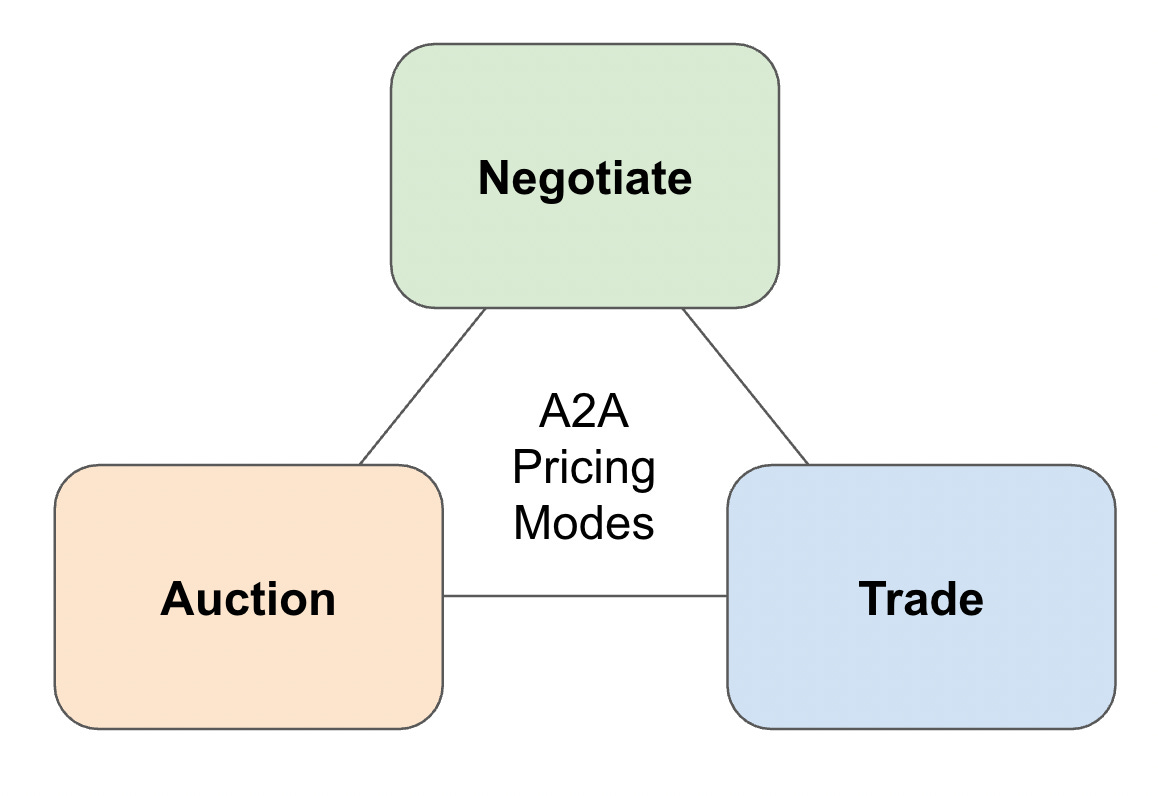
Agent to Agent pricing that does not include value negotiation will put vendors at a disadvantage.
TL;DR — A2A Pricing Modes: Negotiate, Auction, Trade
A2A is already here. Buyer agents are negotiating prices today — in prediction markets, algorithmic trading, and emerging agent marketplaces. This is not a 2028 problem
Three modes will govern B2B agent transactions: negotiate (most complex, most common in B2B), auction (competitive bids, multiple formats), and trade (commodity-like, fixed bid/ask). Most B2B will be negotiated
Mechanism design matters — for now. The four classic auction formats (English, Dutch, First-Price, Vickrey) perform differently with human buyers. Whether agents are more rational actors and make mechanism choice less important is an open question worth watching
Agent marketplaces are the new distribution channel. PulseMCP already has 16,000+ registered agents. Salesforce, HubSpot, Anthropic, and Google are all building agent discovery layers. Discoverability is the new SEO
Stablecoins are becoming the payment rail for agentic commerce. Traditional payment systems require human authentication. Stablecoins settle in under 500ms at fractions of a cent — the only mechanism compatible with machine-speed, autonomous transactions
Competing protocols are fragmenting the stack. ACP (OpenAI + Stripe), UCP (Google), AP2, MCP (Anthropic), and x402 (Coinbase) are all vying for position. Early familiarity pays
Your existing pricing infrastructure will fail agents. PDFs, spreadsheets, and vague pricing pages are invisible to agents. You need machine-readable value models and API-exposed pricing — now
Most B2B companies do not understand their differentiation. Where you sit on the negotiate–auction–trade spectrum depends on how genuinely differentiated your offering is. This is the moment to find out
Six actions to take today: build a machine-readable value model; expose pricing via API; register in agent marketplaces; choose your pricing mode; instrument value delivery for outcomes not usage; appoint one person to own A2A readiness
Agent to Agent (A2A) pricing has begun to attract attention.
Kyle Poyar’s influential Growth Unhinged site published Your next customer may be an AI Agent on April 1, 2026. (Was this an April fool’s joke? I don’t think so.) In a talk I gave to New Ventures BC back in March I asked how many companies had A2A business models and about 7% of the sixty-seven companies present answered yes. Mark Stiving and I will be talking about AI in the buying process in an upcoming podcast.
Some other recent articles investigating A2A pricing are
“Agentic Commerce: When Your AI Agent Negotiates Prices with Their AI Agent” by Sri Ram, March 7, 2026
“The Agent-to-Agent Economy: What Happens When Bots Start Billing” by the AgentTax Team, March 20, 2026.
In some ways this is not new. The majority of trades on most stock markets are made by agents (prompt algorithmic trading on your preferred AI). Many commodities trades are also carried out by the equivalent of agents. Major commerce platforms are preparing for this with competing and incompatible protocols (see the note at the end of this post).
Let’s take a look at some basic principles.
The three modes of A2A pricing
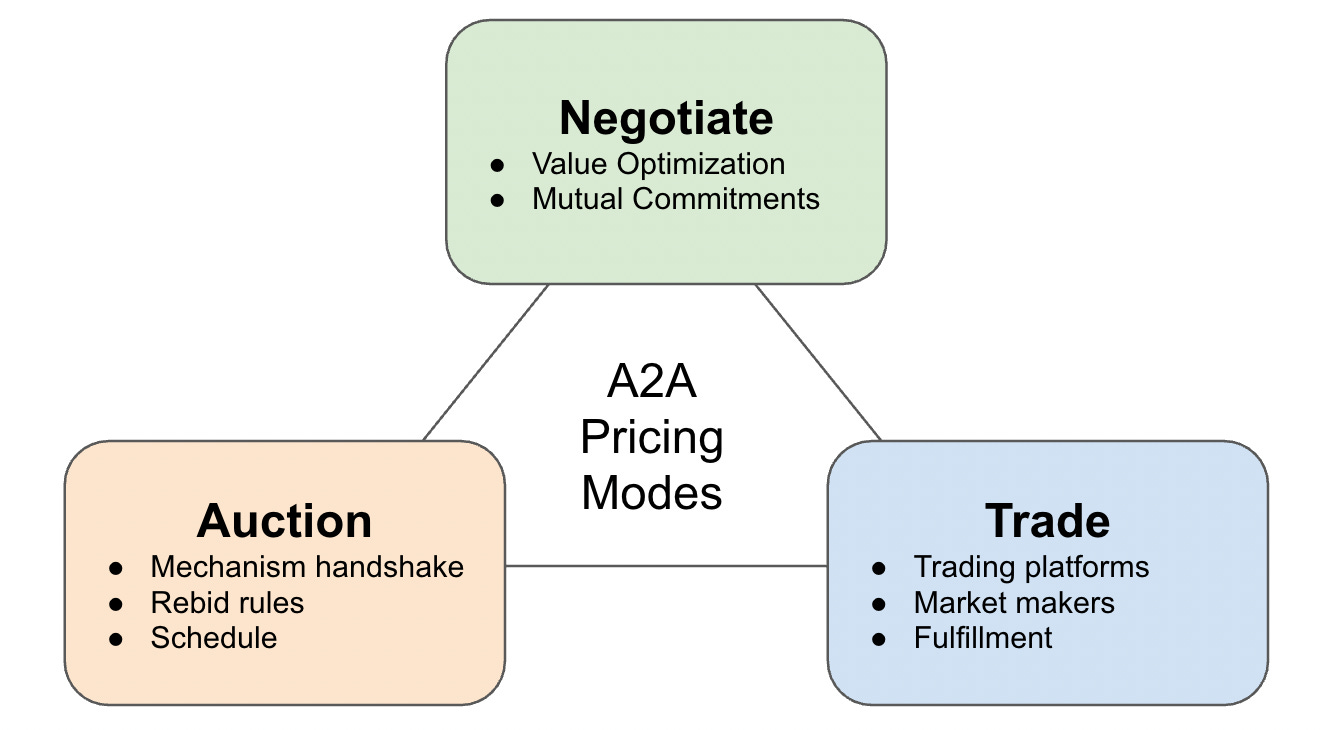
A2A prices can be settled in three ways.
Pricing can be negotiated. The negotiation can be between two agents, or as an intermediate stage, pricing might be negotiated by an agent and a human. It each case, the negotiator may have a coach in the background (generative AI generally works best when there are several ‘intelligences’ interacting to evolve an answer, see Agentic AI and the next intelligence explosion.)
There can be an auction. Auctions could be initiated by the buyer or the seller. The buyer can trigger an auction by saying what they want to buy and by specifying the auction mechanism and basic guidelines. The seller can also offer an auction, and likewise specify the auction mechanism and guidelines. An interesting hybrid is when two or more agents negotiate the type of auction!
There can be a trade. There is a buy price and a sell price for a well defined service to be provided by an agent. In the real world markets require market makers to lubricate the market. The market makers can also be agents.
The simplest services will be priced and transacted by trades. More complex services will be priced with auctions. The most complex services, likely to be most of B2B exchanges, will be negotiated.
Let’s dig deeper into each of these three modes.
Pricing Negotiated Between Agents
This mode that will be the most common. Different (and differentiated) agents that discover each other and want to make an exchange.
The exchanges supported will not be limited to buying and selling. They may also include trades or be mediated through credits.
For this to work several things must be in place. There must be a way for the agents to understand what they need and then to discover agents that can provide this. The discovery should be fairly straightforward, it is just a form of search and there are also many agent registries surfacing. Every major technology vendor will have at least one. For an agent to understand what external data and affordances it needs is a higher level problem. It will be fun to watch as agents develop these capabilities and ask themselves ‘What do I need to do my job better?’
The other thing that is needed is a way for agents to exchange information about value and price.
This will require the sorts of value model that valueIQ.ai is able to generate. Today valueIQ does this for product developers, product markets, pricers and above all sales. In the future agents will call on valueIQ to generate and evaluate agent value models.
Agents will also need to communicate about and negotiate price. This will require a shared way to represent the pricing model, a configuration of that pricing model that aligns with the solution being provided, and the resulting price or invoice. If credit calculators or credit wallets are used, these need to be designed in ways that agents can interact with.
Today most pricing models are locked away in spreadsheets and PDFs. Even pricing pages can be hard to parse, especially when it comes to credit based pricing models. A lot more transparency will be needed, though in some cases the transparency itself will need to be negotiated.
Which brings us to negotiation. Negotiation does not necessarily go away just because agents are involved. Agents will negotiate with each other. There may even be agent coaches that help other agents to negotiate the tradeoffs between value and price. This is all going to be a lot of fun to watch. I hope there will be ways to observe and learn from these agent to agent value and pricing negotiations.
Agents enter an auction
An alternative to negotiation will be auctions. Agents can use auctions to generate competitive bids for services they need to buy. They can also use auctions to get prices for services they can sell. The latter may become common if resources like inference compute are in short supply.
There are many different ways to design an auction, or as experts call it, ‘mechanism’ design. The most common designs are summarized below but there are many others. Theoretically, with the same access to information all mechanisms lead to the same outcome. In practice, at least with humans, this is not true. Will agents be more rational actors and make mechanism design less important? This is one of the things to watch for as agents take over auctions.
Here is a breakdown of the main auction types and the key design principles behind them.
The Four Classic Auction Formats
These four formats are the foundation of auction theory:
English (Ascending) Auction — The most familiar format. The price starts low and bidders openly compete by raising their bids. The last remaining bidder wins and pays their final bid. Used for art, antiques, and real estate.
Dutch (Descending) Auction — The auctioneer starts at a very high price and lowers it until someone accepts. The first bidder to say “yes” wins at that price. Used for flowers, government bonds, and IPO shares.
First-Price Sealed-Bid — Everyone privately submits one bid simultaneously. The highest bidder wins and pays exactly what they bid. Used for government contracts and high-value assets.
Second-Price Sealed-Bid (Vickrey Auction) — Same as above, but the winner only pays the second-highest bid, not their own. This was formalized by William Vickrey, who won the 1996 Nobel Prize in Economics for it.
Agents trade on a market
Markets are more complicated than they may appear. You need ways for agents to communicate the price at which they are willing to buy, willing to sell, a settlement mechanism and a market clearing mechanism. For A2A B2B these are still in their infancy.
These are all well established on stock, bond and commodities exchanges, and algorithmic trading is the dominant form of trading in terms of volume. For a fun read check out Michael Lewis’ book Flash Boys, a bit dated now, but it surfaces many of the key issues and motivations.
We can see a new generation of agentic trading emerging on prediction markets like Polymarket. This site has been getting a lot of negative publicity lately, but prediction markets are here to stay and are becoming more and more useful. I use Polymarket regularly as a signal of the likelihood of various uncertain futures and am experimenting with it as a way to hedge different future scenarios.
Automated agents and trading bots have become the dominant force in Polymarket's market structure, accounting for an estimated 50–90% of trading volume depending on market type. A tiny cohort of 2% of wallets — overwhelmingly algorithmic — drives approximately 88–90% of the platform's total trading volume. Arbitrage bots alone extracted an estimated $40 million in profits between April 2024 and April 2025. Polymarket does not ban automated trading; it actively supports it through an open API and an officially published agent framework.
For more detail see 2% of Users Contribute 90% of Trading Volume: The True Portrait of Polymarket.
Agent marketplaces like those being developed by Salesfoce, Hubspot, etc. will become places where agents can discover each other, negotiate exchanges of services, set up auctions and conduct trades. Protocol specific marketplaces for things like Anthropic skills and MCP (Model Context Protocol) like PulseMCP will evolve into actual marketplaces where agents trade with each other. PulseMCP has more than 16,000 registered agents!
Combinations of modes
Negotiation, Auctions and Trading are the main modes of B2B Agent transactions, but there will also be hybrid forms. One of these was mentioned above where agents negotiate the auction mechanism. Other possibilities are combinations of auctions and market places (at an abstract level marketplaces are auctions) and of negotiations and marketplaces. Historically there is a trend away from negotiations in market places as it can slow things down and add friction to the transaction. Is that belief still valid when it is agents that are doing the negotiation? Will negotiation between agents become part of fast paced A2A interactions?
Innovation is driven by finding new ways to combine things. All sorts of hybrid combinations of the three basic modes are likely to emerge and transform how agents transact in B2B.
Getting ready for A2A in B2B
What are some things you should be doing today to prepare for A2A transactions in B2B? Prepare for fundamental change as pricing friction disappears.
1. Build a Machine-Readable Value Model
The most important thing you can do today is articulate your value model in a form that agents can read and reason about. Nagle’s core insight — that price should be anchored in differentiated economic value — doesn’t change when the buyer is an agent. What changes is that the agent cannot read a PDF or parse a vague pricing page. Your value model needs to express, in structured form, what outcomes you deliver, for which customer segments, and against which competitive alternatives. Tools like valueIQ.ai are already being designed for exactly this. If you haven’t started building a formal value model, start now — not for agents, but because it will sharpen your positioning with human buyers immediately.
2. Get Your Pricing Model Out of Spreadsheets
Most pricing models are locked away in spreadsheets and PDFs. That is a problem for humans. It will be fatal for A2A transactions. An agent negotiating on behalf of a buyer needs to be able to query your pricing model, configure it for their specific use case, and receive a valid price or invoice — programmatically. This means:
Expose your pricing model through an API, even a simple one
Document your value metric clearly — what unit of value are you charging for, and why
Make credit-based pricing legible; credit wallets and calculators must be designed for agent interaction
You don’t need a perfect solution. You need a start. A well-documented pricing schema in JSON is a reasonable first step.
3. Register in Agent Marketplaces Now
There are already more than 16,000 registered agents on PulseMCP alone. Salesforce, HubSpot, and every major platform vendor are building agent marketplaces where agents discover, negotiate with, and transact with other agents. Discoverability is the new SEO. Register your agent or your service in the relevant marketplaces now, before the crowd arrives. Think of it the same way you thought about getting on G2 or Capterra in 2015 — early movers capture disproportionate visibility.
4. Decide Where You Sit on the Negotiate–Auction–Trade Spectrum
The three modes of A2A pricing — negotiation, auction, and trade — are not equivalent. Commodity-like services will be transacted as trades. More complex B2B services will be negotiated. You need to have an honest answer to the question: how differentiated is my offering, really? If your service is well-defined and comparables exist, design for trade-based pricing with clear bid/ask mechanics. If your offering is genuinely differentiated — which is what value-based pricing requires — design for agent negotiation, which means your agent needs to be able to articulate and defend your differentiated value. Most B2B software companies overestimate how differentiated they are. This is the moment to find out.
5. Instrument Your Value Delivery
Agents will negotiate on the basis of outcomes, not features. This means you must be able to demonstrate, in real time, the value your solution is delivering. Start instrumenting your product today so that you can produce a value delivery report — not just a usage report. What cost did you reduce? What revenue did you generate? What risk did you eliminate? If you cannot answer these questions with data, an agent negotiating for your buyer will simply move on to a competitor who can. This is Tom Nagle’s economic value estimation made operational at machine speed.
6. Appoint Someone to Own A2A Readiness
This is the simplest step and the most frequently skipped. Assign a single person — a product manager, a pricing leader, a head of growth — to own A2A readiness as a defined initiative. They do not need to solve everything. They need to track the emerging protocols (MCP, Anthropic skills, and whatever Salesforce and HubSpot announce next), map which agent registries matter for your market, and run a quarterly review of what it would take for a buyer’s agent to transact with your company without human intervention. The companies that win in A2A commerce will be those that treated it as a capability to build, not a trend to watch.
Conclusions
A2A pricing is not a future scenario. It is happening now, in prediction markets, in algorithmic trading, in the agent marketplaces already accumulating thousands of registered services. The question is not whether your buyers will eventually send agents to negotiate. It is whether you will be ready when they do.
Three modes — negotiate, auction, trade — will govern most B2B agent transactions. Your position on that spectrum is not a technical question. It is a strategic one, rooted in how honestly you can answer how differentiated is my offering, really?
The companies that will lose are not the ones that ignore agents entirely. They are the ones that assume their existing pricing and positioning will translate. An agent cannot read your PDF. It cannot parse a vague pricing page. It will move on in milliseconds.
Six things to do now:
Build a machine-readable value model — this sharpens positioning with human buyers immediately, and becomes essential for agents
Get your pricing model out of spreadsheets and expose it through an API
Register in agent marketplaces before the crowd arrives — discoverability is the new SEO
Decide where you sit on the negotiate–auction–trade spectrum based on your actual level of differentiation
Instrument your value delivery so agents can see outcomes, not just usage
Appoint one person to own A2A readiness as a defined initiative with a quarterly review cadence
The underlying economics have not changed. Tom Nagle’s insight — that price should be anchored in differentiated economic value — is as valid as ever. What has changed is the speed, the scale, and the precision with which buyers will test whether you actually deliver that value.
Build the infrastructure now. The agents are coming.
Note on Agentic Commerce Protocols
There is a lot of work going on in agentic commerce. The focus is on eCommerce but some will attempt to use these protocols for B2B and others will build new protocols informed by these efforts.
There is a lot of noise right now, but the noise is a result of a creative explosion and now is the time to familiarize yourself with this work.
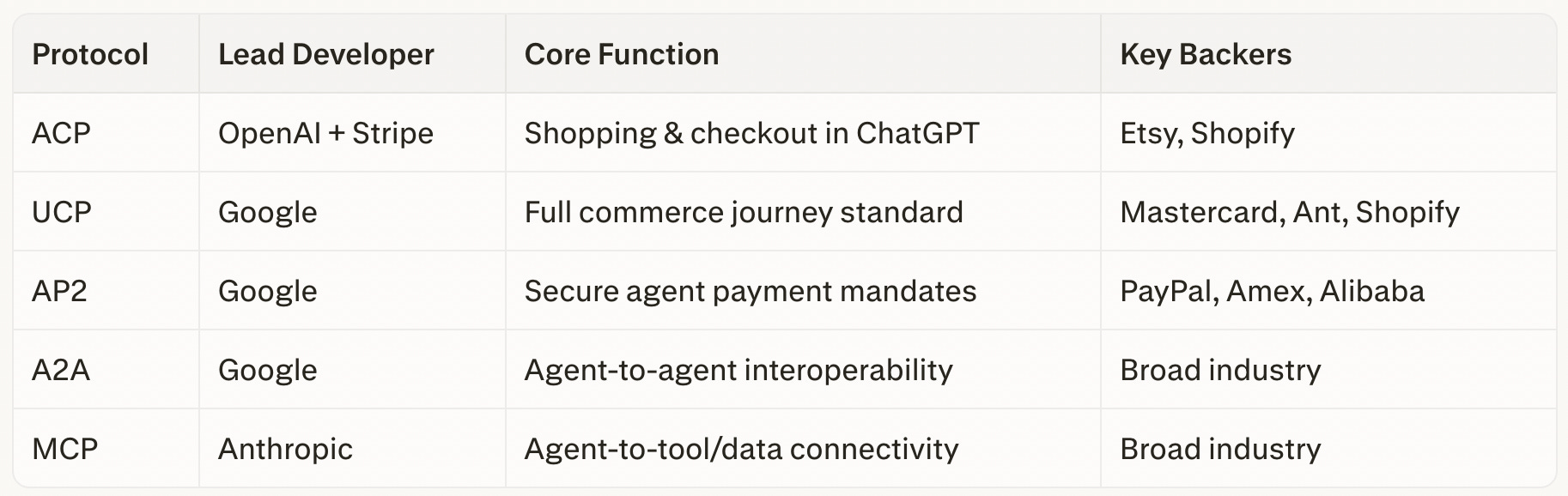
Agentic Commerce Protocol (ACP)
ACP was co-developed by OpenAI and Stripe, launched in late 2025. It enables AI agents like ChatGPT to act as personal shopping agents — browsing, comparing, and completing purchases without the user leaving the chat environment. The protocol launched with Etsy and expanded to Shopify, and is designed as an open standard that merchants can integrate without replacing their existing commerce backends. Key capabilities include checkout, identity linking via OAuth 2.0, order management, and buyer consent management.
Universal Commerce Protocol (UCP)
Google launched the Universal Commerce Protocol at NRF in January 2026, co-developed with partners including Mastercard, Ant International, and Shopify. UCP is an open standard designed to cover the entire shopping journey — discovery, purchasing, and post-purchase support — through a single common language for agents, merchants, and payment providers. Crucially, it is built for interoperability and is explicitly compatible with related protocols: Agent2Agent (A2A), Agent Payments Protocol (AP2), and Model Context Protocol (MCP).
Agent Payments Protocol (AP2)
Google launched AP2 in September 2025 as a secure, open standard specifically for the payment layer of agent-led transactions. It is backed by major financial infrastructure players including Mastercard, PayPal, American Express, Adobe, and Alibaba. Trust is enforced through cryptographically signed mandates that make agent transactions verifiable and auditable — a critical requirement for delegating purchasing authority to AI.
Supporting Protocols
Two broader agent infrastructure protocols also underpin agentic commerce:
Agent2Agent (A2A): Google’s protocol for agent-to-agent interoperability, enabling specialized agents (e.g., a travel agent and a payment agent) to coordinate seamlessly
Model Context Protocol (MCP): Anthropic’s open standard for connecting AI agents to tools and data sources; ACP is built to integrate with it
Protocol Landscape
Note on Stablecoin transactions
Stablecoins have become the dominant payment rail for agentic commerce because they are the only settlement mechanism natively compatible with how autonomous AI agents operate — programmatically, continuously, and at machine speed.
Why Traditional Payments Break for Agents
AI agents are software entities that discover services, negotiate terms, and execute transactions without human intervention. Traditional payment systems were designed for human authentication — they rely on CAPTCHAs, MFA, card networks, and bank-approval workflows that are fundamentally incompatible with autonomous, machine-initiated transactions. As Circle CEO Jeremy Allaire put it, “using a Visa card or initiating a bank transfer is ludicrous” at agent scale — agents need a medium that can transact to fractions of a cent, rapidly, across applications and borders.
Why Stablecoins Fit
Stablecoins solve three core problems simultaneously:
Price stability: Unlike volatile crypto, stablecoins are pegged to fiat currencies (USD, EUR), making them reliable for pricing and budgeting within agent logic
Settlement speed: Crypto settlements happen in under 500 milliseconds at costs below $0.001, making high-frequency micropayments economically viable
Programmability: Smart contracts on networks like Ethereum allow agents to execute verifiable, auditable transactions between themselves without human intermediaries
24/7 operation: AI agents don’t rest; stablecoin rails don’t have banking hours, wire cutoffs, or weekend delays
Instant onboarding: Agents can be provisioned with a stablecoin wallet without bank approval, bypassing KYC friction that would block autonomous operation
Emerging Infrastructure Protocols
Three competing protocol layers are crystallizing as of early 2026:
ProtocolSponsorFunctionx402CoinbaseHTTP-native micropayment standard for agent-to-API monetizationAP2 (Agent Payment Protocol)NeverminedAuthorization and delegation framework for agent-to-agent paymentsACP (Agentic Commerce Protocol)Stripe + OpenAIFull commercial workflow: discovery, negotiation, purchase, fulfillment
These protocols are technically complementary — AP2 can wrap x402 as a payment method, while ACP can orchestrate transactions that settle via either. Stripe’s Tempo, a stablecoin chain built with Paradigm, positions this within a full commerce stack.
Real-World Adoption Signals
Stablecoin volume reached $46 trillion annually (a 106% year-over-year increase), indicating the infrastructure can handle AI-scale payment volumes. Agent-related crypto projects surged from 5% to 36% of all crypto AI deals between H2 2023 and H1 2025. On the regulatory side, OCC Bulletin 2026-3 (February 2026) tied to the GENIUS Act has begun treating stablecoin issuers as core financial infrastructure. OpenAI’s “Instant Checkout” in ChatGPT is an early mass-market implementation, using Stripe Shared Payment Tokens to push agentic checkout into a mainstream consumer interface.
The Structural Logic
The deeper reason stablecoins fit agentic commerce is that both are fundamentally software-native. An agent managing a procurement workflow needs to hold funds, pay APIs, sub-contract to other agents, and reconcile — all programmatically. Stablecoin transactions are also inherently transparent and auditable, which satisfies the explainability requirements increasingly demanded of autonomous systems. The AI agents market is expected to grow from $7.84 billion in 2025 to $52.62 billion by 2030, and stablecoins are effectively becoming the treasury and settlement layer for that entire economy.